Where to Find Entry Level Salesforce Jobs (and Spot Fake Listings)
- No computer science degree required
- Built for 3+ years of professional experience
- We never ask you to pay an employer to get hired
You passed the exam, polished your resume, and opened a job board. Then reality hits: hundreds of listings, half of them stale, some of them strange, and a few that are flat out fake. Knowing where entry level Salesforce jobs actually get posted, and how to spot the listings that waste your time or steal your money, is now a core job search skill. If you are still deciding whether the role fits you, read what a Salesforce admin actually does all day before you start applying.
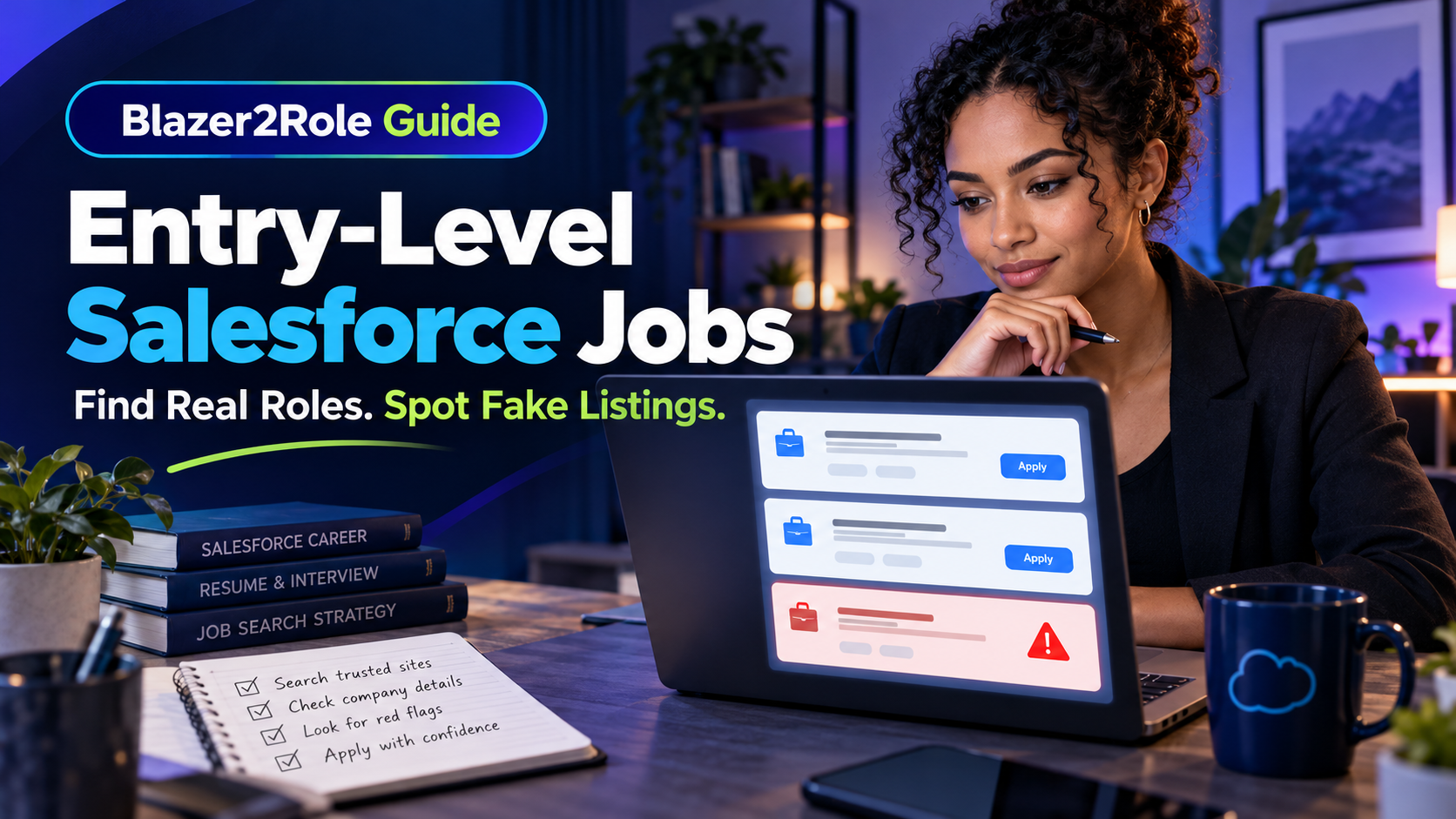
Look beyond the big job boards. Entry level Salesforce roles also come through the Trailblazer Career Marketplace, Salesforce consulting partners, companies in your current industry, and local user groups. Skip listings that look stale, and walk away from any offer that asks you to pay, chat only by text, or share bank details early.
In this guide
- Where entry level Salesforce jobs get posted
- Job titles to search beyond Salesforce Admin
- Ghost jobs: why some listings never answer
- Fake listings and job scams to avoid
- A ten minute check before you apply
- A weekly search system that beats mass applying
- Questions people ask
Where entry level Salesforce jobs get posted
No single site holds every Salesforce opening. Each source below reaches a different slice of employers, so a good search uses several at once.
- Big job boards: LinkedIn, Indeed, and Glassdoor carry the most listings, and the most competition. Use them, but filter hard by posting date and job title so you only see fresh, relevant roles.
- Trailblazer Career Marketplace: a free extension of Trailhead where job seekers can discover jobs and connect directly with employers in the Salesforce ecosystem. Per Salesforce's Trailhead module, employers there have been limited to Salesforce Partners since December 2023, so expect mostly consulting firm roles.
- Consulting partners directly: many Salesforce implementation partners hire junior consultants and support staff to work under senior team members. Check the careers pages of partners in your region, not just the biggest names.
- Companies in your current industry: a hospital, school district, nonprofit, or retailer that uses Salesforce may value your industry knowledge more than a stranger's extra certification. Search the company name plus Salesforce.
- Trailblazer Community groups: local and virtual user groups share openings, and members often refer people they have met. One conversation there can beat fifty cold applications.
- Staffing agencies and contracts: short contracts are a common first step into the ecosystem. Read the terms carefully, but do not dismiss them.
Here is the first honest concession: there is no secret job board that only insiders know about. The advantage comes from combining sources and moving fast on fresh listings, not from finding a hidden site.

Job titles to search beyond Salesforce Admin
Many beginners search only for Salesforce Administrator and miss half the roles they qualify for. Employers use different titles for very similar work.
- Junior or associate Salesforce administrator: the obvious one, and the most crowded.
- Salesforce analyst or CRM analyst: often focused on reports, dashboards, and data quality.
- CRM coordinator or CRM specialist: common in nonprofits, schools, and smaller companies.
- Sales operations or revenue operations coordinator: supports sales teams and usually lives inside Salesforce all day.
- Salesforce support specialist: handles user questions, access, and small fixes, which is excellent first job experience.
- Business systems analyst: gathers requirements and works with admins, a natural fit for people from operations or project roles.
Read the duties, not the title. If a listing describes managing users, building reports, and fixing data, it is admin work no matter what it is called. Our guide to entry level Salesforce salary shows how pay varies across these titles and cities.
Ghost jobs: why some listings never answer
A ghost job is a listing for a role that is already filled, on indefinite hold, or never meant to be filled. They are not rare. Analysis cited in a 2025 Columbia Law Review piece, drawing on Greenhouse data, estimated that roughly 20 percent of active listings are ghost jobs, and Revelio Labs found hires per job posting fell from about eight for every ten listings in 2019 to about four in 2024.
Signs a listing may be a ghost:
- Age: it has been posted, or reposted, for more than 30 days with no change.
- Vague duties: the description could fit almost any company and names no team, tools, or projects.
- Always hiring: the same role appears every month on the company page.
- No human attached: no recruiter or hiring manager is named anywhere, and nobody at the company mentions the role online.
- Freeze news: the company recently announced layoffs or a hiring freeze but kept the listing up.
Second concession: you cannot always tell a ghost from a slow real listing. Some real roles take months to fill. The fix is not to avoid older listings completely, but to spend your best effort on fresh ones and treat stale ones as quick applications only.
Fake listings and job scams to avoid
Ghost jobs waste time. Fake jobs take money. According to the FTC's December 2024 data spotlight, reported losses to job scams grew from about $90 million in 2020 to about $286 million in 2023, and topped $220 million in just the first half of 2024. Reports of task scams, where people are told to pay to unlock earnings, jumped to about 20,000 in the first half of 2024, compared with about 5,000 in all of 2023.
Red flags that show up in tech and Salesforce job scams:
- Pay to start: any request to pay for training, a certification voucher, software, equipment, or a background check before you are hired. Real employers do not charge you to work.
- Unexpected text offers: a text or WhatsApp message offering remote work with no specific company, title, or duties.
- Chat only interviews: the whole interview happens over text, with no video call and no named interviewer.
- Checks for equipment: they mail you a check to buy a laptop from their vendor and ask you to send part of it back.
- Early personal data: they want your bank details or government ID before a written offer exists.
- Brand impersonation: someone claims to recruit for Salesforce itself, but the email domain does not match and the role is missing from the official careers site.
- Too good to be true: senior level pay for a junior role with no experience required and an offer within a day.

A ten minute check before you apply
Run this quick check on any listing that looks promising but unfamiliar. It takes about ten minutes and saves hours of wasted applications.
- Find the same role on the company's official careers page. If it is not there, be cautious.
- Check the posting date and whether the listing has been reposted repeatedly.
- Look up the company on LinkedIn and confirm it has real employees, including people with Salesforce titles.
- Confirm the recruiter's email uses the company domain, not a free email service.
- Search the company name plus scam or review and read what other candidates experienced.
- Read the duties for specific tools, teams, and projects. Real teams describe real work.
- If anything asks for money or banking information before a written offer, stop there and report it.
If you see a scam, report it to the job board and to the FTC at ReportFraud.ftc.gov. Reports help warn the next job seeker.
A weekly search system that beats mass applying
Sending hundreds of identical applications feels productive, but it rarely works in a crowded entry level market. A steady weekly system does better.
- Daily fresh scan: spend twenty minutes each morning on listings posted in the last few days, across at least three sources.
- Tailor the top few: rewrite your summary and top bullets for the best matches each week, using the employer's own words.
- Show proof: link one documented portfolio project so a hiring manager sees what you can build.
- Fix your profile: recruiters check LinkedIn before they reply, so follow our guide to a LinkedIn profile for Salesforce jobs.
- Ask for referrals: message one person each week at a company you want to join. Ask about the team, not for a job.
- Track everything: log the source, date, and response for every application so you can see what converts.
Third concession: even a strong system takes time. Many career changers search for several months, and remote roles are the most crowded, as our look at remote Salesforce jobs explains. If months pass with no interviews, review the common gaps in certified but no job, and run your resume through the Blazer2Role Resume Scorer before sending more.
Blazer2Role sells the coaching and courses described here. That includes Job Application Search at $150 USD per month (10 searches per day). We do not guarantee job placement, and we will never ask you to pay an employer for a job. If you are unsure whether a listing or a recruiter is real, email support@blazer2role.com and we will help you check it.
Questions people ask
Where can I find entry level Salesforce jobs?
Use several sources at once: LinkedIn and Indeed with tight date filters, the Trailblazer Career Marketplace for Salesforce partner roles, careers pages of consulting partners, companies in your current industry that use Salesforce, and Trailblazer Community user groups. Combining sources and applying to fresh listings matters more than any single site.
What job titles should I search for as a Salesforce beginner?
Search for junior or associate Salesforce administrator, Salesforce analyst, CRM analyst, CRM coordinator, Salesforce support specialist, sales operations coordinator, and business systems analyst. Titles vary by company, so read the duties. If the work involves managing users, building reports, and cleaning data, it is admin work.
How can I tell if a Salesforce job posting is fake?
Warning signs include requests to pay for training or equipment, interviews held only by text, unexpected WhatsApp job offers, recruiters using free email addresses, and demands for bank details before a written offer. Confirm the role on the company's official careers page and check that the company has real employees on LinkedIn.
What is a ghost job?
A ghost job is a listing for a role that is already filled, on hold, or never meant to be filled. Analysis cited in a 2025 Columbia Law Review piece estimated about 20 percent of active listings are ghost jobs. Old postings, vague duties, and constant reposting are common signs.
Is the Trailblazer Career Marketplace worth using?
Yes, as one source among several. It is free, connected to your Trailhead profile, and lets you reach employers in the Salesforce ecosystem directly. Since December 2023, employers there have been limited to Salesforce Partners, so expect mostly consulting firm roles rather than jobs at end user companies.
Should I pay for Salesforce job placement help?
Never pay an employer or recruiter to get hired. Paying for coaching or a job search service is a different decision, so judge it by what is delivered, not by promises. Avoid any program that guarantees a job, and ask exactly what you get, how often, and what happens if it does not work.
Tired of sorting real listings from ghosts and scams by yourself? See Job Application Search on our pricing page, $150 USD per month with 10 searches per day, and compare it with the other Blazer2Role tiers before you decide.