What Does a Salesforce Admin Do? A Real Day in the Life
- No computer science degree required
- Built for 3+ years of professional experience
- Salesforce exam fee never bundled into a tier
Most people researching this career have read the job title a hundred times and still cannot picture the work. Job posts say "own the platform" and "drive adoption" without saying what you touch between nine and five, and that gap is where people stall out. It is hard to commit a year of study to a job you cannot visualize. If you are still deciding whether the role fits you, our roadmap for becoming a Salesforce admin with no experience maps the longer path. This guide answers the narrower question first: what the day looks like.
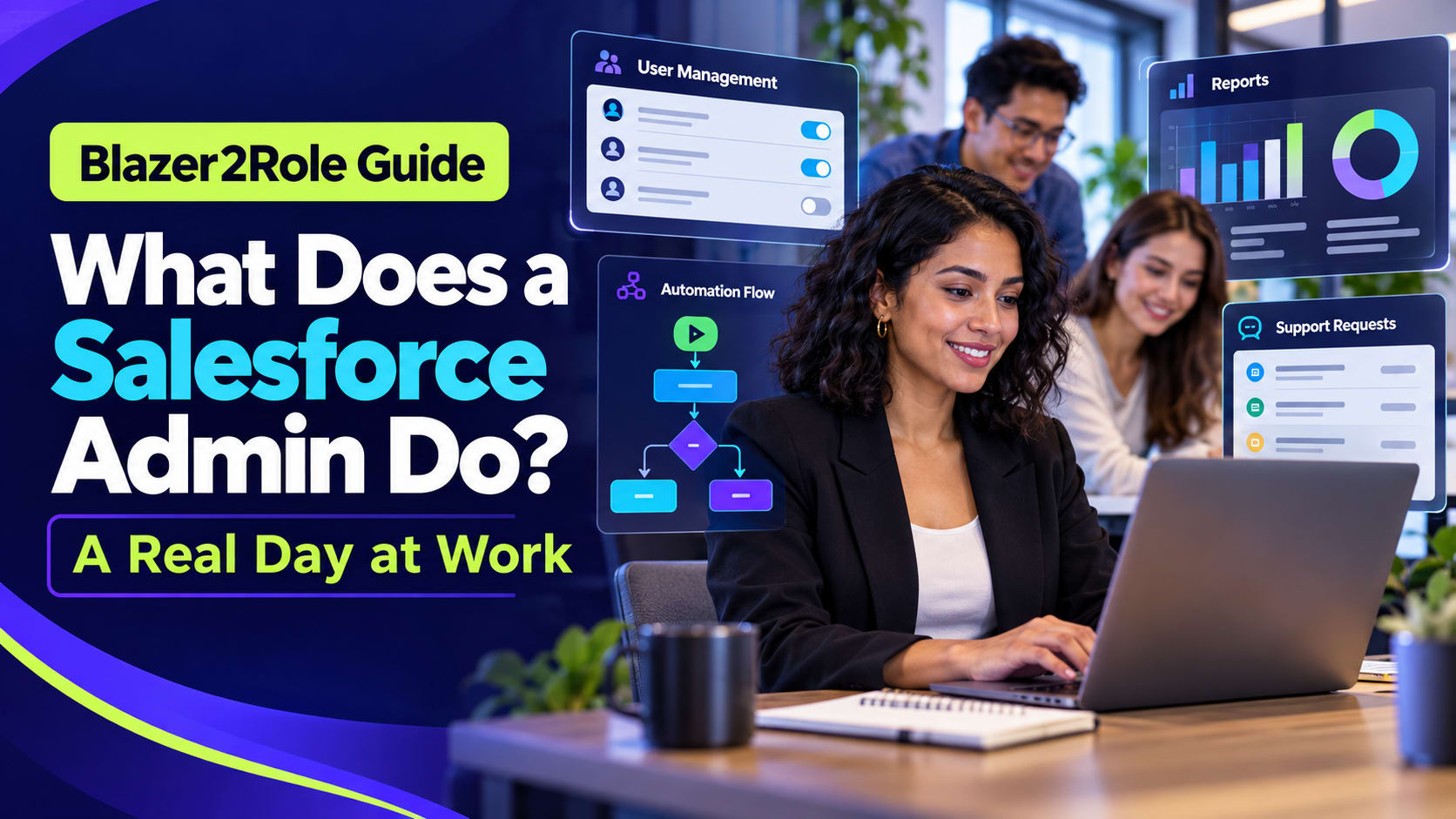
A Salesforce admin keeps one company's CRM working: user accounts and permissions, data quality, reports and dashboards, automation, and a steady queue of requests from sales and service teams. Honestly, most days are small fixes and questions rather than big builds, and the people side takes more time than the clicking does.
In this guide
- A real day in the life of a Salesforce admin
- The five buckets the job splits into
- What the job actually asks of you
- What the role pays and where it goes next
- How to get there from a non-technical job
- Questions people ask
A real day in the life of a Salesforce admin
Picture a mid-size company with roughly 200 Salesforce users across sales, service, and finance, and you are the one admin. Nobody schedules your day for you, which sounds freeing until you realize the queue schedules it instead.
The morning usually opens with the inbox and the ticket queue. A rep cannot see an account she owns. A new hire starts Monday and needs a license, a profile, and a role in the hierarchy. A manager wants last quarter's pipeline split by region before a ten o'clock call. None of these take long alone. Together they eat the first two hours.
Midday tends to be the real work: building a validation rule so reps stop leaving the close date blank, cleaning up 4,000 duplicate contacts after a trade show import, or testing a screen flow in a sandbox before it touches live data. This is the part that looks like the job you signed up for, and on a busy week it is the part that gets squeezed.
Afternoons skew toward people. You sit with the sales operations lead to translate "we need better forecasting" into something a system can do, record a two minute video showing the service team where the new case layout moved, and tell someone politely that the field they want already exists under a different name.
Here is the honest shape of a typical week:
- Support and requests: the largest slice most weeks, covering user setup, access issues, and small fixes, which job descriptions consistently list as day-to-day administration and end user support.
- Reports and dashboards: recurring builds for leadership plus ad hoc requests that arrive with no notice, named in nearly every admin job posting reviewed for this guide.
- Configuration and automation: objects, fields, page layouts, permission sets, validation rules, and flows.
- Data quality: imports, deduplication, and the ongoing argument about required fields.
- Meetings and documentation: stand-ups, requirement conversations, and keeping a record of why the org is configured the way it is.
The concession worth making early: if you want a job where you build uninterrupted for six hours, this is not it. The work is real, but it arrives in fragments.
The five buckets the job splits into
Strip away the company-specific noise and nearly every Salesforce admin role reduces to the same five responsibilities, which published job descriptions repeat almost word for word.
- Users and security: creating and deactivating users, assigning profiles, permission sets, roles, and public groups, and keeping the sharing model tight enough that people see only what they should.
- Configuration: custom objects and fields, record types, page layouts, validation rules, and the Lightning app experience the business actually clicks through.
- Automation: flows that route a lead, update a field, or create a follow-up task without anyone remembering to, which is where the role creates most of its measurable value.
- Reporting: report types, dashboards, and the pipeline and KPI views leadership opens every Monday, listed as a core duty in the Salesforce Certified Administrator exam outline itself.
- Adoption and support: training, documentation, troubleshooting, and being the person everyone asks before the vendor.
Notice what is missing. You are not writing Apex, managing servers, or shipping code. That belongs to developers, which is why the admin versus business analyst comparison matters more than most beginners expect when they pick a lane.

What the job actually asks of you
The technical bar is lower than the career-change forums suggest and the communication bar is higher. The Salesforce Certified Administrator exam has no prerequisites and no coding section; it covers managing users, data, and security, maintaining Sales Cloud and Service Cloud, and building reports and dashboards, per the official Salesforce Administrator credential page.
What separates admins who last from admins who burn out is rarely platform knowledge. It is these:
- Translation: turning a vague business complaint into a specific, testable change. "Our data is a mess" is not a requirement. "Reps can save an opportunity without a close date" is.
- Saying no with a reason: every custom field is permanent debt, and admins who add whatever is asked end up maintaining an org nobody understands.
- Documentation discipline: you will not remember why you built that flow in March, and neither will your replacement.
- Patience with repetition: you will reset the same permission and answer the same question many times, and each person still deserves a straight answer.
If you have spent 3+ years in operations, customer service, project coordination, teaching, or healthcare admin, you already have most of that. The transferable skills guide goes deeper on how to name them on a resume. A second honest concession: the people-heavy nature of the role is a genuine mismatch for some career changers who wanted tech work precisely to get away from stakeholder management. If that is you, it is better to learn it now than after the exam fee.
What the role pays and where it goes next
Salary ranges for this title are wide because a first-year admin and an eight-year admin share one job title. Treat averages as the middle of a long line, not as a starting offer.
- Entry level: about $58,859 on average, with a reported range of roughly $44,000 to $75,000, per PayScale 2026 data for entry-level Salesforce administrators.
- All experience levels: about $91,573 on average across the United States, per Indeed salary data updated July 2026.
- Admin-specific survey average: about $98,250 for US admins, per the Salesforce Ben ecosystem salary survey cited in the Kore1 2026 salary guide.
- Mid-level midpoint: $107,500, per the Robert Half 2026 Technology Salary Guide.
- Exam cost: $200 USD registration and $100 USD for a retake, per the Salesforce Certified Administrator exam guide.
The third concession, and the important one: the headline averages near $90,000 to $100,000 are not what a career changer with zero Salesforce experience is offered. The entry-level figure is the realistic one, and in a lower cost metro it lands under that. Our breakdown of entry level Salesforce salary covers why the first number matters less than the second and third.
Where it goes next is the better argument for the role. Admins commonly move into business analyst, consultant, platform owner, or senior admin work, and senior administrator pay averages roughly $124,000 per Indeed 2026 data. That progression is the real case for the job, not the starting salary.

How to get there from a non-technical job
The sequence that works for working adults is boring, and short. You do not need to quit anything to start it.
- Spend two weeks in a Salesforce developer org doing real tasks, not watching videos. Create users, break the sharing model, fix it.
- Work the admin learning path until the exam objectives feel like clicks you have already done, not vocabulary.
- Build two or three portfolio pieces that solve a problem you recognize from your current job, following our guide to Salesforce portfolio projects with no experience.
- Sit the Administrator exam once you are consistently scoring above the passing mark on practice sets, not before. It is 60 questions in 105 minutes with a 65 percent passing score.
- Rewrite your resume around the five buckets above, then apply while you keep building.
Blazer2Role sells the coaching and courses described here. The Certification Track is $999 USD one time and covers structured exam preparation and coaching, and the Salesforce exam fee is not included in that tier or in any other tier. We do not guarantee job placement. No honest program will. If you want to ask whether the role fits your background before paying for anything, email support@blazer2role.com and ask plainly.
Questions people ask
What does a Salesforce admin do on a daily basis?
Daily work is a mix of user administration, access and permission fixes, report and dashboard requests, data cleanup, and small configuration changes. Most admins also sit in at least one meeting translating a business request into a system change. The balance shifts by company size, but support requests and reporting take the largest share on a normal week.
Is Salesforce admin a hard job?
The platform itself is learnable without a technical background, since the exam has no coding section and no prerequisites. The harder parts are interruption management and stakeholder communication. If you have handled competing requests in operations, service, or coordination roles, the difficulty will feel familiar rather than new. The technical learning curve is steepest in the first three months.
Do you need coding for a Salesforce admin role?
No. Administration is configuration work done through the setup interface: objects, fields, permission sets, validation rules, flows, reports, and dashboards. Apex and Lightning Web Components belong to developer roles. Some admins eventually learn formula syntax and basic SOQL for reporting, but neither is required to pass the certification or hold the job.
How much does a Salesforce admin make?
Entry-level administrators average about $58,859, per PayScale 2026 data, while the average across all experience levels is about $91,573, per Indeed data updated July 2026. The Robert Half 2026 Technology Salary Guide puts the mid-level midpoint at $107,500. Location, industry, and certification count for more than the national average suggests.
Can I become a Salesforce admin with no experience?
Yes, and most career changers do, though the first role is the hardest to get and usually arrives after several months of applying. Hands-on practice in a developer org, the Administrator certification, and two or three portfolio projects are the standard combination. Prior business experience in operations or service genuinely helps rather than being filler.
What is the difference between a Salesforce admin and a developer?
Admins configure the platform using built-in tools and own users, data, reporting, and automation. Developers write Apex and custom code for logic the platform cannot handle through configuration. Many organizations hire admins first because most business needs are solvable without code, which is also why admin roles outnumber developer roles at entry level.
Is Salesforce admin a good career in 2026?
It remains a realistic entry point into technology work for people without a computer science degree, with a clear progression toward business analyst, consultant, and senior admin roles. The caveat is that entry-level competition is heavier than it was five years ago, so the certification alone no longer stands out. Demonstrated hands-on work does.
Does your resume show any of the five buckets above? Run it through the Blazer2Role resume scorer and see which admin responsibilities a hiring manager can actually find on the page.