Salesforce Admin vs Salesforce Developer: Which Should a Career Changer Pick?
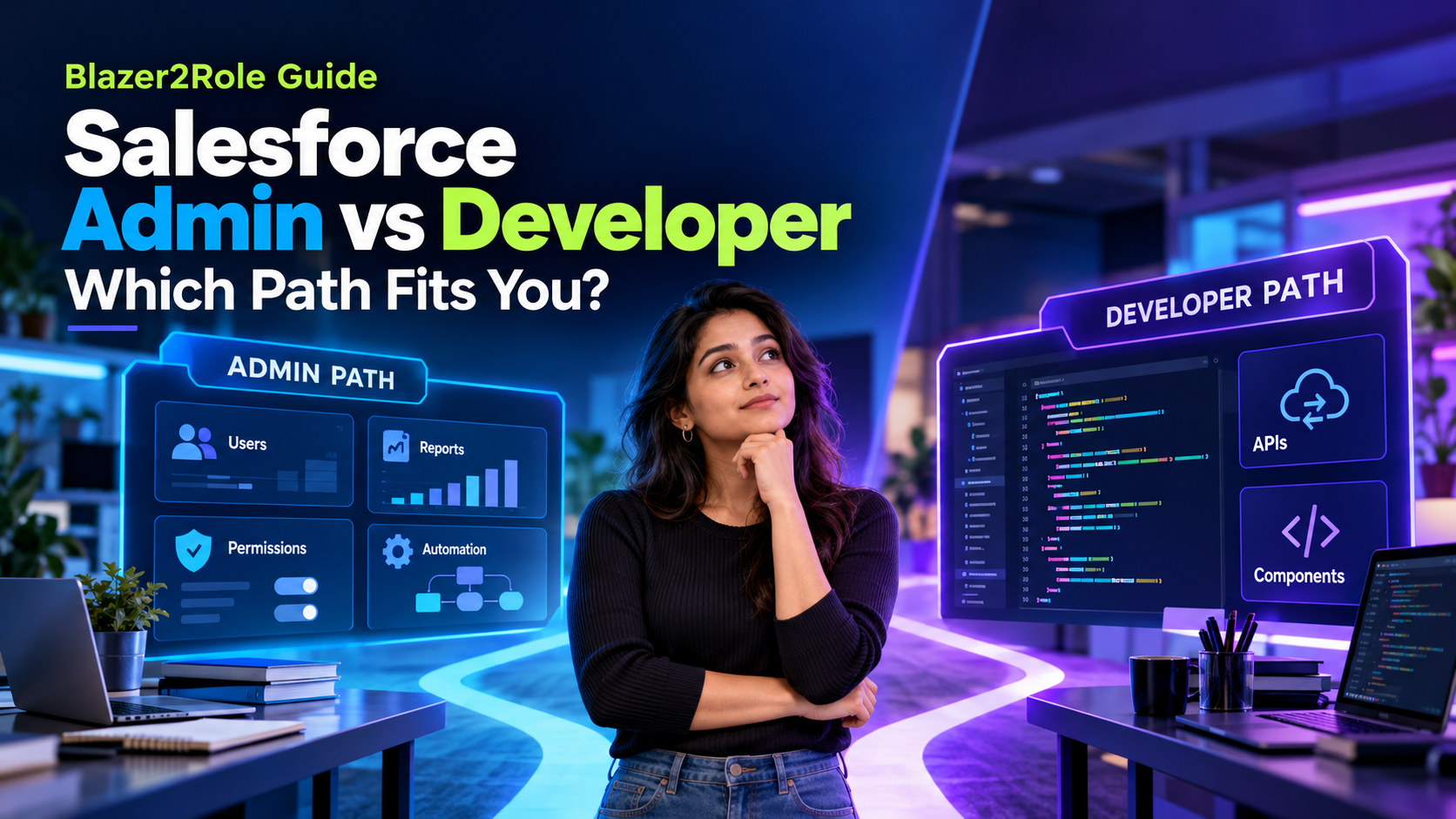
- No computer science degree required
- Built for 3+ years of professional experience
- 2026 pay data from named sources, side by side
If you are leaving a nontechnical job for Salesforce, the first fork in the road shows up fast. One path builds with clicks, settings, and Flow. The other builds with Apex and JavaScript. This guide compares the Salesforce admin vs developer decision the way a career changer has to make it: daily work, sourced 2026 pay, how crowded each door is, and what you already do well. If you want the admin side in more detail first, read what a Salesforce admin actually does all day.
Most career changers with business experience should start as a Salesforce admin, because the role rewards process knowledge and needs no coding on day one. Pick the developer path if you already enjoy programming. Neither door is easy right now, and developer roles ask for more study before your first offer.
In this guide
- The core difference: clicks or code
- What each role does day to day
- What each role pays in 2026
- How crowded each entry point is
- Which path fits your background
- Starting as an admin and moving into code later
- A 30 day test before you commit
- Questions people ask
The core difference: clicks or code
Salesforce gives every company two ways to change how the system works. The first is declarative: you configure objects, fields, page layouts, permissions, reports, and automation through point and click tools. The second is programmatic: you write code that runs on the platform. Admins own the first. Developers own the second.
That split explains most of what follows. Admins work with the business: listening, turning requests into settings, and protecting data quality. Developers work with code: building logic the click tools cannot handle, testing it, and shipping it safely.
- Admin toolset: Setup menus, Flow for automation, validation rules, permission sets, reports and dashboards, and data import tools.
- Developer toolset: Apex (Salesforce's own programming language), Lightning Web Components built with JavaScript, SOQL queries, integrations with other systems, and deployment tooling.
- Shared ground: Both need to understand the data model, security, and how users actually work.
Salesforce describes the developer credential as proof that you can build custom logic and interfaces with code. See the official scope on the Salesforce Certified Platform Developer credential page.
What each role does day to day
Here is what a typical week can look like on each side, based on how teams usually split the work.
- Admin, morning: Reset a locked user, fix a permission issue, and clean up a batch of duplicate records someone imported last night.
- Admin, afternoon: Meet a sales manager who wants a new field and report, then build a Flow that creates a task when a deal reaches a certain stage.
- Developer, morning: Pick up a ticket the click tools cannot solve, such as a complex calculation or a connection to an outside billing system.
- Developer, afternoon: Write Apex plus the test classes Salesforce requires, then deploy from a sandbox to production.
Notice who each role talks to. Admins spend much of the week with users and managers, while developers spend more time with tickets, code reviews, and other technical people. If you love fixing things for a team, that is an admin signal. If you love the quiet focus of a logic puzzle, that points toward code.

What each role pays in 2026
Developers earn more at every level in the data we checked. The cleanest comparison comes from the Salesforce Ben 2026 salary survey of 2,316 Salesforce professionals, which reports US medians.
- Junior admin: $78,000 median, per the Salesforce Ben 2026 survey.
- Junior developer: $94,500 median, per the same survey.
- Intermediate admin: $92,000 median, per the same survey.
- Intermediate developer: $120,000 median, per the same survey.
- Senior admin: $109,000 median, per the same survey.
- Senior developer: $140,000 median, per the same survey.
Recruiter data runs higher. Salesforce Ben's 2026 roundup lists a Mason Frank median of $110,000 for admins and $150,000 for developers, and a Stott and May median of $120,000 for admins and $140,000 for developers. The same article says recruiter figures tend to run about 10 to 20 percent above its survey, so treat them as the upper edge, not a likely first offer. For a closer look at first year pay on the admin side, see our entry level Salesforce salary reality check.
Higher pay on paper comes with a catch, though. Salary tables show what people earn once hired, not how many junior openings exist, and Salesforce Ben notes its figures do not account for job availability. A bigger number behind a door that rarely opens is not automatically the better bet.
How crowded each entry point is
Here the picture flips. Salesforce Ben, citing 10K's 2025 Salesforce Talent Ecosystem Report, published these global figures comparing 2025 with 2024 (demand is based on job listings):
- Admin demand: up 14 percent, after several years of decline.
- Admin supply: up 47 percent, which means many more people are competing for those roles.
- Developer demand: down 12 percent, the only role in the report to decrease.
- Developer supply: up 20 percent, though growth slowed from 24 percent in 2024.
The admin door has more openings than before, but far more people are walking toward it. The developer door has fewer openings while supply keeps growing, and Salesforce Ben suggests AI may be automating repeatable tasks, which could create a bottleneck for entry level developers. So starting as an admin is not a shortcut: expect more applicants per opening, with your business background as the thing that sets you apart.
Which path fits your background
Your past job is evidence. Look at which list sounds more like the work you already do well.
- Lean admin if: you have run a process, trained coworkers, cleaned up messy spreadsheets, worked in sales operations or customer service, or been the person everyone asks how a system works.
- Lean developer if: you have written formulas that got out of hand, automated something with scripts or macros, enjoyed a coding class, or felt more energized by a logic problem than by a meeting.
- Either path works if: you are patient with detail and willing to keep learning as Salesforce ships three releases a year.
Career changers with three or more years in a business role often carry the admin signals without noticing. Knowing why a sales team hates a certain report is domain knowledge that tutorials cannot teach. Our list of Salesforce job titles beginners can apply for besides admin shows nearby roles that use the same skills.

Starting as an admin and moving into code later
You do not have to pick forever. Many people start in admin work and pick up Apex once the job demands it. Salesforce Ben's 2026 careers guide calls this an admineloper hybrid, a progression strategy 20 percent of admins chose.
That makes admin a lower risk starting point for many career changers. You learn the data model, security, and Flow first, which every developer also needs, and you find out on the job whether code excites you. If you are still unsure what to study first, our guide to the Salesforce skill to learn first explains why Flow comes before Apex for most job seekers, and our breakdown of which Salesforce certification to take first covers the credential side.
A 30 day test before you commit
Spend a month doing a small version of both jobs, then decide with evidence instead of guesses.
- Sign up for a Salesforce Developer Edition org so you have your own practice space.
- In week one, build a custom object, fields, and a report for a business you know well.
- In week two, build a record triggered Flow that creates a task or sends an alert when a field changes.
- In week three, complete a beginner Apex module and write one small trigger with its test class.
- In week four, write down which week you looked forward to and which week you put off. That reaction is your answer.
Blazer2Role sells the coaching and courses described here. We do not guarantee job placement. The Salesforce exam fee is never bundled into any Blazer2Role tier, so check the current fee on Trailhead before you book either exam. If you want help deciding which path fits your background, email support@blazer2role.com.
Questions people ask
Which is better, Salesforce admin or developer?
Neither is better in general. Admin suits people who like working with users, processes, and business problems, and it needs no coding to start. Developer suits people who enjoy programming and want a higher pay ceiling, per Salesforce Ben's 2026 survey medians. For most career changers with business experience, admin is the more natural first step, with code added later if it interests you.
Do Salesforce developers make more than admins?
Yes, at every level in the 2026 data we checked. Salesforce Ben's survey reports medians of $78,000 for junior admins and $94,500 for junior developers, rising to $109,000 and $140,000 at senior level. Recruiter figures from Mason Frank and Stott and May run higher, with developer medians of $140,000 to $150,000, not broken out by level.
Can a Salesforce admin become a developer?
Yes, and it is a common path. Many admins learn Apex once their team needs custom logic, sometimes before their title changes. Because admins already understand the data model, security, and Flow, the move into code builds on existing knowledge. Plan for real study time, since Apex and Lightning Web Components require programming skills that the admin role does not teach.
Do I need to know coding to be a Salesforce admin?
No. Admin work is built on declarative tools such as Flow, validation rules, permission sets, and reports, which you configure without writing code. That said, admins who can read a little Apex or understand formula logic tend to troubleshoot faster and talk to developers more easily, so basic exposure helps over time even though it is not required to start.
Is Salesforce developer harder than admin?
For most career changers, yes, the developer path takes longer to learn. Developers need everything an admin knows about the data model and security, plus programming in Apex and JavaScript, testing, and deployment. Admin work has its own difficulty, mostly in handling people, unclear requests, and messy data, but it does not require learning a programming language first.
Which Salesforce certification should a career changer take first?
For the admin path, start with the Salesforce Certified Platform Administrator credential. For the developer path, the Salesforce Certified Platform Developer credential is the usual starting point, though many people earn the admin credential first to learn the platform. Check current exam details on Trailhead, and remember that hands on practice in a Developer Edition org matters as much as the badge.
Not sure which path your resume already points to? Run it through the Blazer2Role Resume Scorer to see which transferable skills stand out before you choose admin or developer.